Loop to Win: Value created from recycling materials in Automotive

Looping valuable materials, piece by piece, product by product.
In a pioneering collaboration, Carbon Cleanup and KTM Technologies have joined forces to transform waste into high-performance products. By combining Carbon Cleanup’s advanced carbon fiber recycling technology with KTM Technologies’ deep expertise in lightweight engineering and product development, the partnership demonstrates how circular economy solutions can be applied to the world of high-performance mobility.
This case study highlights how recycled carbon fiber and polypropylene can be re-integrated into high-value compounds for injection molding and fiber needle materials for BMC applications. The collaboration showcases not only the technical feasibility of recycling high-performance composites, but also the business value it unlocks for KTM’s product range.
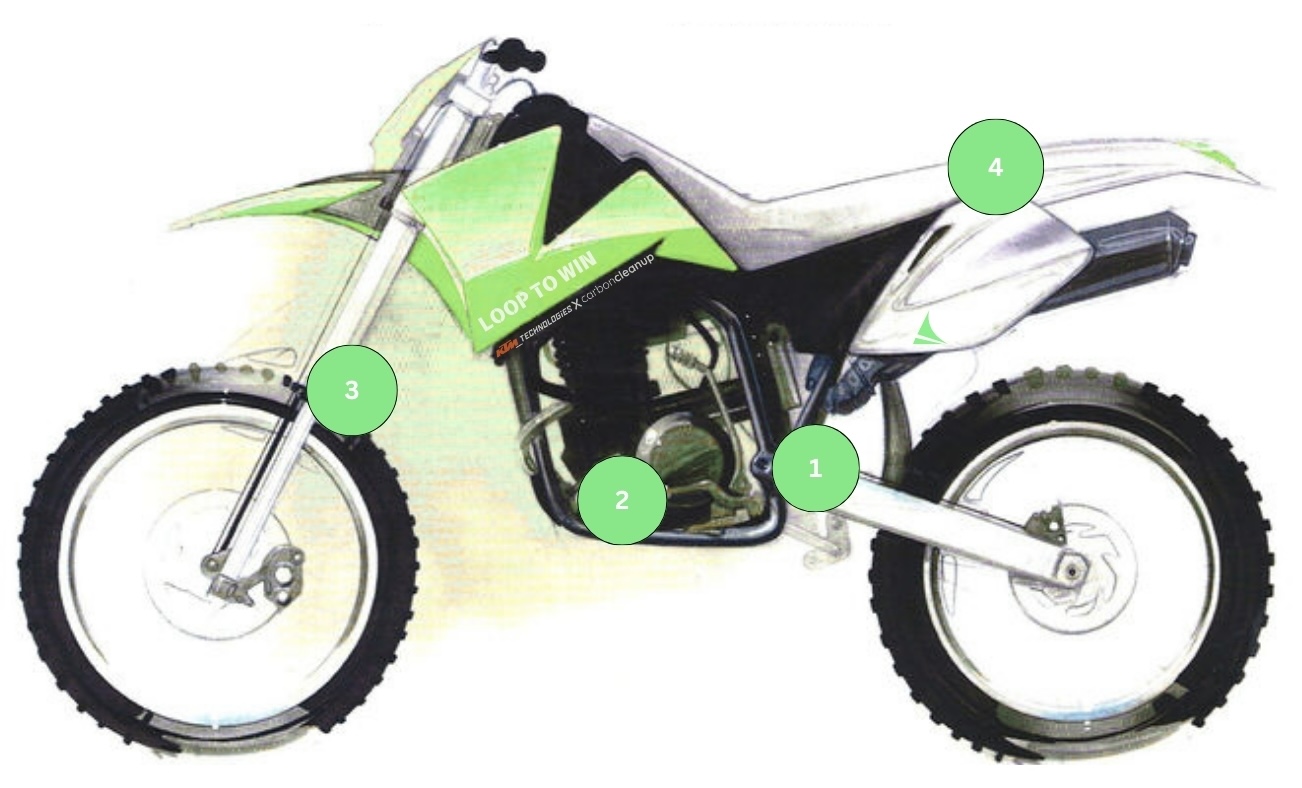
The collaboration resulted in four demonstrator parts that showcase how recycled carbon fiber compounds can combine performance with sustainability:
1) FRAME PROTECTION: Framing a future, where nothing goes to waste.
2) SKID PLATE: Small parts, big impact.
2) BRAKE DISK GUARD: Hitting the breaks on emissions
4) SEAT: Taking a seat in the front row of sustainable innovation
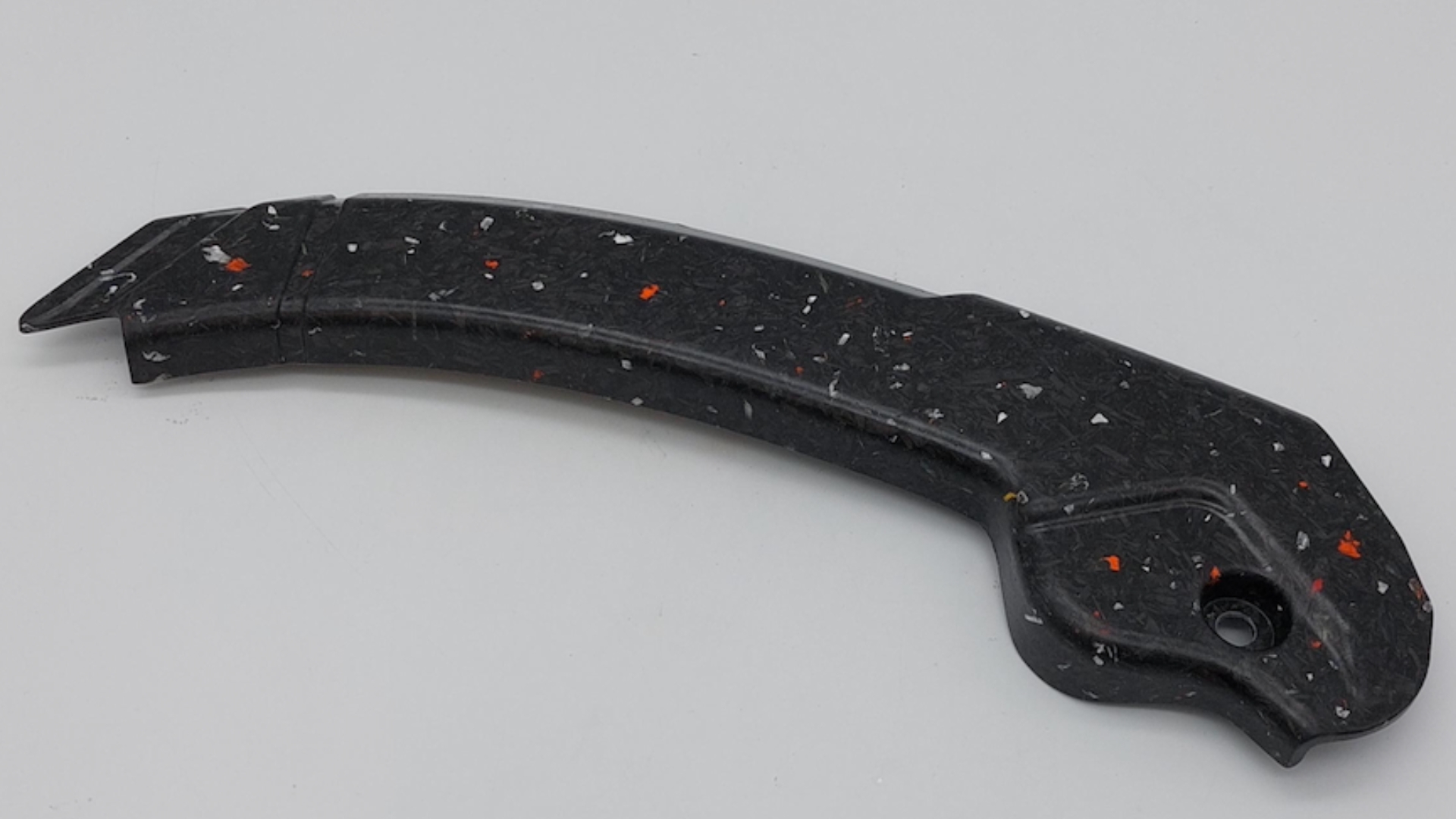
FRAME PROTECTION
Frame Protection: Framing a future, where nothing goes to waste
Carbon fiber is everywhere, from high-performance bikes to aerospace and automotive
parts. But with that comes a major problem: waste. Every year, around 62,000 tonnes of
carbon fiber end up as scrap, much of it from industries like aerospace and wind energy.
And unlike other materials, carbon fiber doesn’t just break down or get easily repurposed.
It is commonly estimated that around 30% of produced carbon fiber ends up as waste.
Recycling carbon fiber isn’t as simple as melting down aluminum or reshaping plastic.
Post-consumer waste is tough to recover because the fibers are embedded in resins that
make them difficult to separate. The most common recycling methods today, like pyrolysis
(burning off the resin), often damage the mechanical properties of the fiber. That’s why
many companies still opt for virgin carbon fiber, even though it’s resource-intensive to
produce.
Chemical recycling has been explored as an alternative, but it’s expensive, energy-hungry,
and inefficient. In many cases, the cost of recycling outweighs the benefits, making it more
practical to use new carbon fiber rather than recycled materials.
But what if there was a way to recover carbon fiber without compromising its strength and
quality? A method that allows manufacturers to close the loop and reuse carbon fiber in
their own supply chains? That would be a no-brainer.
Regulations are already pushing for change. The EU’s End-of-Life Vehicle Directive is just
one example, requiring automakers to recycle more materials from their cars. But the
industry still lacks scalable, high-quality recycling solutions. The challenge goes beyond
meeting sustainability goals- it’s about finding a way to make recycling actually work for
manufacturers.


.svg)
.svg)